Free vs Paid AI Directories: Which Should You Choose in 2026?
Compare free vs paid AI directories in 2026. Discover key differences, ROI frameworks, quality checklists, and the best hybrid launch submission strategy.
📌 Article Overview
A comprehensive evaluation of free vs paid AI directories in 2026. Discover how website directory submission, SEO directory submission, and targeted AI product marketing drive indexation, backlink authority, and referral traffic.
Introduction: Free vs Paid AI Directories in 2026
When executing an AI product launch or building initial distribution for an early-stage SaaS startup, founders quickly encounter a vast ecosystem of software catalogs, startup launchpads, and discovery portals. Almost immediately, you face a strategic choice: Should you rely on free vs paid AI directories, or deploy a hybrid submission strategy?
Deciding how to submit website to directories can feel confusing. Free directory submission options eliminate upfront financial risk, making them attractive for bootstrapped teams wanting to generate initial digital footprint. On the other hand, paid directory submission sites promise faster processing speeds, priority placement, featured newsletter exposure, and direct editorial inspection.
However, assuming that "paid is automatically superior for SEO" is a dangerous misconception in modern growth marketing. Paying a listing fee does not guarantee high domain authority, DoFollow link attributes, rapid Google indexation, or instant referral conversions. Conversely, many free website directory submission portals boast massive organic search traffic, strict curation standards, and high domain authority.
This comprehensive guide provides an honest, practical framework for founders, indie hackers, and SaaS marketers. We compare free directory submission sites free against paid catalogs, detail what to check before paying, explain how to identify low-quality submission sites, and demonstrate why combining high-quality free and paid options forms the ultimate growth engine for AI startup promotion.
What Are Free AI Directories?
Free AI directories are open software aggregators and catalog portals where developers and founders can submit AI startup listings, web apps, browser extensions, or machine learning models without paying upfront listing fees.
How They Work & Typical Submission Process: Free platforms rely on ad revenue, community contributions, or optional paid upgrades to maintain operations. Executing a free directory submission typically involves registering an account, submitting your root URL, writing short and detailed product descriptions, assigning taxonomy categories, and submitting for moderation.
Common Characteristics:
- Open Submission Queues: Profiles join a chronological review queue managed by volunteer editors or automated verification filters.
- Standard Catalog Profiles: Offers standard listing real estate featuring product title, core description, category tags, screenshots, and direct website links.
- Community Voting Mechanics: Platforms like Product Hunt or Hacker News utilize user upvotes and community bookmarking to feature trending tools.
Core Advantages: Zero financial cost, simple experimentation, broad availability across hundreds of niche catalogs, and zero risk when testing messaging.
Core Disadvantages: Slower approval turnaround times, potential queue backlogs, variable editorial standards, and the manual labor required to submit your site to online directories individually.
What Are Paid AI Directories?
Paid AI directories are curated discovery engines that charge a submission, review, or sponsorship fee to evaluate and publish your software listing.
Submission Fees & Pricing Models: Paid AI startup directories generally utilize three primary pricing structures:
- Fast-Track Expedited Review: A nominal fee ($10 to $50) to jump ahead of standard queues and receive editorial feedback within 24 to 72 hours.
- Permanent Directory Listing: A single editorial fee required to catalog your product permanently in specific category taxonomies.
- Featured Sponsorship Packages: Premium tiers ($50 to $500+) offering homepage banner spots, sticky category positioning, social media amplification, or newsletter features.
Editorial Curation: Top paid platforms invest submission revenue into dedicated moderation teams to verify software functionality and maintain clean directories. However, paying a fee guarantees editorial review—not guaranteed inclusion or search performance.
Core Advantages: Accelerated review times, guaranteed editorial response, opportunities for featured placements, and exposure to targeted buyer audiences.
Core Disadvantages: Direct cash expense, zero guarantee of traffic or rankings, varying backlink attributes, and the risk of paying low-quality link schemes.
Free vs Paid AI Directories: Quick Comparison
The following detailed breakdown compares key metrics between free directory submission sites free and paid submission platforms:
| Feature / Metric | Free AI Directories | Paid AI Directories |
|---|---|---|
| Cost | $0 submission fee | $10 to $500+ (expedited / featured) |
| Approval Speed | 3 days to 4+ weeks | Fast (24 to 72 hours) |
| Editorial Review | Community filters or manual queue | Guaranteed human editorial inspection |
| Backlink Possibility | High (Platform dependent) | High (Platform dependent) |
| Link Attributes | DoFollow, NoFollow, or UGC | DoFollow, NoFollow, or Sponsored |
| Traffic Potential | Moderate to High on major aggregators | High if featured in active newsletters |
| Brand Exposure | Standard category listing | Featured badges, hero spots, newsletters |
| Domain Authority | Ranges from DR 10 to DR 90+ | Ranges from DR 15 to DR 90+ |
| Relevance | Defined by category taxonomy | Defined by category taxonomy |
| Long-Term Value | High compounding equity at $0 cost | High ROI on vetted, high-traffic portals |
| Risk Profile | Very Low (Time cost only) | Moderate (Financial loss if low quality) |
Advantages of Free AI Directories
Utilizing free directory submission platforms offers distinct strategic advantages for early-stage software companies:
1. Zero Cash Outlay
Financial accessibility is the defining perk of free directories. Bootstrapped solo founders and indie hackers can submit website to directories free without spending marketing capital, preserving runway for product development.
2. Safe Value Proposition Testing
Free platforms serve as an ideal sandbox for testing software positioning, value descriptors, taglines, and screenshots. Observing click-through trends across free listings helps refine your core messaging prior to launching paid marketing campaigns.
3. Broad Footprint Expansion
The web features hundreds of free tech aggregators, local business catalogs, and AI product repositories. Submitting across multiple platforms creates a multi-sourced backlink profile and strengthens brand entity citations. For foundational insights, read Why AI Directory Submissions Matter for AI Startups in 2026.
4. Immediate Beta Feedback
When conducting an MVP or beta test, early adopters frequent free directory platforms seeking novel tools. This traffic provides early user engagement and feedback loops.
Disadvantages of Free AI Directories
Despite their accessibility, free directory listings carry operational drawbacks:
1. Inconsistent Curation Quality
Because open catalogs do not charge fees, some smaller sites lack strict moderation. Unmoderated platforms can collect thin or spammy listings, diluting overall directory quality.
2. Traffic Volatility
Referral traffic from free listings varies significantly. Major open portals generate high referral volumes, while niche directories might yield only a handful of visits monthly.
3. Processing Delays
Due to high submission volumes, free queues can back up. Approvals may take several weeks unless expedited processing is available.
4. Time-Intensive Manual Labor
Selecting categories, uploading images, creating accounts, and tailoring copy for dozens of sites requires dozens of founder hours if executed manually.
Advantages of Paid AI Directories
Investing selectively in paid directory listings delivers distinct promotional benefits when evaluated properly:
1. Rapid Turnaround & Guaranteed Feedback
Paid submissions jump standard queues, delivering editorial evaluation within 24 to 72 hours. This speed allows teams to coordinate listings with launch announcements.
2. Dedicated Editorial Standards
Fees support active moderation teams that filter broken links, verify software utility, and maintain clean directory environments.
3. Premium Visibility Features
Paid options often include homepage hero banners, top-of-category sticky positioning, and features in subscriber newsletters sent directly to active software buyers.
4. Targeted Buyer Exposure
Established paid directories rank organically for commercial software keywords, placing your product directly in front of active B2B software buyers.
Disadvantages of Paid AI Directories
Paid listings also carry specific risks that demand careful vetting:
1. Outlay Without Guaranteed Conversion
Paying a submission fee guarantees review or listing placement, but never guarantees search rankings, referral traffic, signups, or customer revenue.
2. Paid Does Not Equal High Authority
Many low-quality directory sites charge fees while possessing near-zero organic search traffic and poor domain authority. Price does not equal quality.
3. Mixed Backlink Attributes
Paid listings do not automatically yield DoFollow backlinks. Responsible directories utilize rel="nofollow" or rel="sponsored" link attributes to conform to search engine guidelines.
What Should You Check Before Paying?
Before spending marketing budget on any paid directory submission sites, execute this vetting checklist:
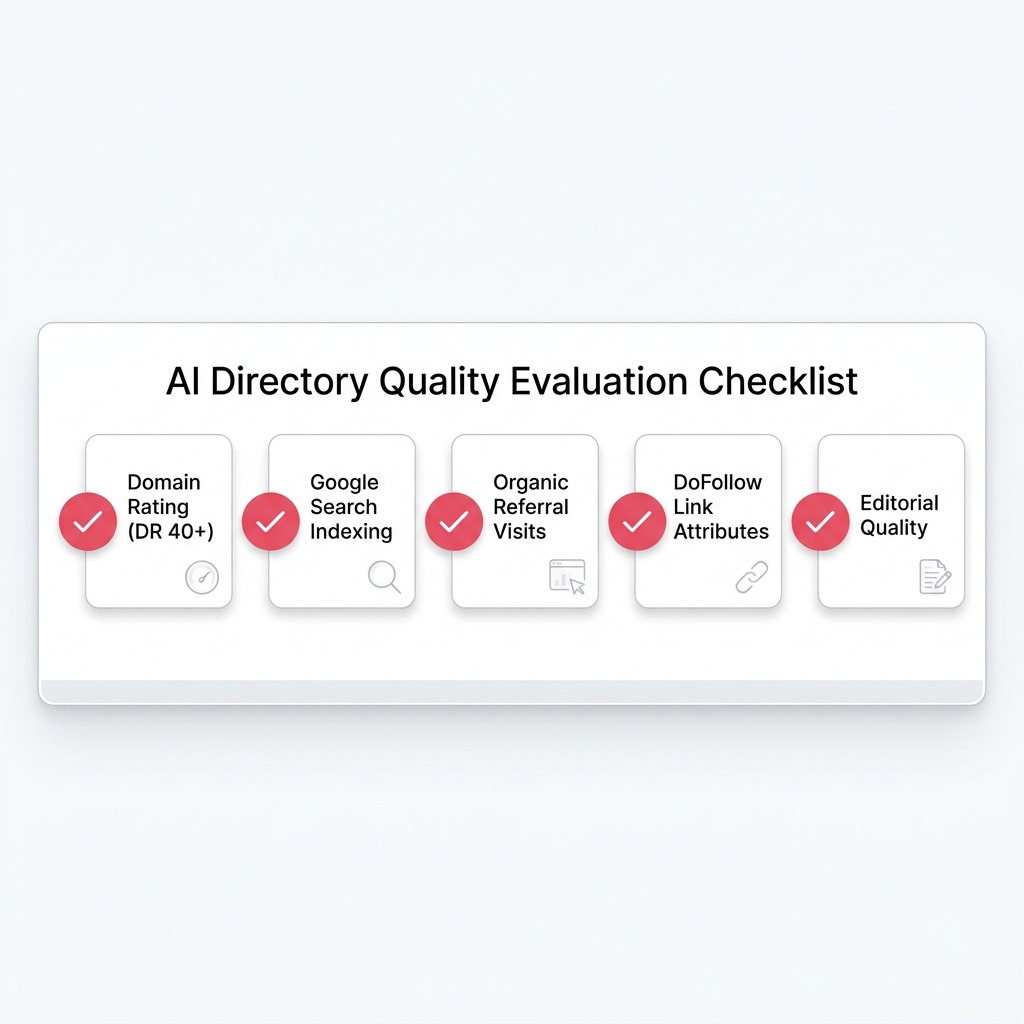
📋 Paid Directory Evaluation Checklist
- ✓ Domain Authority & Link Profile: Check Ahrefs DR or Semrush AS to ensure the domain possesses genuine authority and natural link growth.
- ✓ Organic Traffic Verification: Ensure the site receives authentic search engine traffic rather than relying solely on paid ads or bot loops.
-
✓
Google Indexation Rate: Perform a site query (
site:directorydomain.com/tool/) to verify that subpages are actively indexed. -
✓
Outbound Link Attributes: Inspect listing links with developer tools to determine whether URLs use
DoFollow,NoFollow, orSponsoredtags. - ✓ Site Design & UX: Inspect user experience. Avoid slow, cluttered templates built solely to sell links.
- ✓ Category Fit: Ensure accurate, active categories match your specific product niche.
- ✓ Spam Level: Ensure existing listings consist of legitimate software tools, avoiding spammy verticals.
How to Identify a Low-Quality Directory
Protecting your brand reputation requires avoiding suspicious website directory submission networks. Watch for these major warning signs:
- Thousands of Unsorted Pages: Portals dumping thousands of links into generic, unmoderated pages.
- Explicit Link-Selling Claims: Sites promising "Guaranteed DoFollow PageRank Boosts" or operating link farm networks.
- Deindexed Domain Pages: Platforms penalized by search engines where product pages no longer appear in search results.
- Intrusive Advertisements: Portals covered in popups, display ads, and auto-playing media.
- Unrealistic Marketing Guarantees: Services claiming directory submissions will "Guarantee 10,000 visitors overnight."
Are Free AI Directories Worth It?
Yes. Submitting your tool to reputable free directories provides essential backlink diversity, brand citations, and indexation pathways without financial expenditure. For early-stage teams, free directory submissions deliver exceptional sweat equity return.
Are Paid AI Directories Worth It?
Yes, when carefully targeted. Paying for directory listings makes financial sense when the platform has high domain authority (DR 60+), real organic traffic, rapid approval turnarounds for time-sensitive launches, or targeted newsletter sponsorships.
Should You Use Both Free and Paid Directories?
The most effective strategy combines free directory scale with targeted paid speed in a diversified 4-phase hybrid approach:
Phase 1: Foundational Free Submissions
Submit your startup across major free AI directories to build initial backlink equity and initiate search engine crawl budget indexation.
Phase 2: Targeted Paid Acceleration
Select 3 to 5 high-authority paid directories catering directly to your software niche for fast approval and newsletter exposure.
Phase 3: Vertical Category Submissions
Submit to specialized industry catalogs (e.g., developer tools, marketing automation) regardless of cost model, prioritizing audience alignment.
Phase 4: Performance Tracking
Monitor referral traffic, trial conversions, and backlink indexation in Search Console. Reinvest in top-performing channels. Discover top platforms in 100+ AI Directories to Submit Your Startup.
Free vs Paid: What Should a New AI Startup Do?
Align your submission playbook with your startup's operational resources:
💡 Bootstrapped Founders & Solo Developers
Focus 90% of effort on high-quality free directory submission. Use manual sweat equity or a cost-effective submission service to save time while preserving cash.
🚀 Venture-Backed AI SaaS Companies
Combine broad free directory coverage with fast-track paid listings and featured newsletter sponsorships on premium DR 70+ platforms to accelerate market entry.
🛠️ Open-Source AI Projects
Focus on free developer aggregators, GitHub registries, and open-source catalogs where developer communities engage naturally.
How Much Should You Spend?
Evaluate directory expenditures using a clear value equation rather than arbitrary price tags:
Expected Value = Submission Cost ÷ Expected Outcome Units
Where Expected Outcome Units measure referral visitors, lead signups, brand impressions, and backlink authority.
Paying $50 for a niche directory listing that generates 200 targeted referral visits and 2 paid customer signups delivers instant positive ROI. Conversely, paying $100 for an unindexed directory with zero organic traffic is a loss regardless of site claims.
Manual Submission vs Paying for a Submission Service
Founders generally execute directory distribution through three operational approaches:
- In-House Manual Submissions: Complete control at zero service cost, but consumes 30 to 50+ hours of repetitive founder labor.
- Automated Bot Submissions: Fast and cheap, but carries high risks of submission errors, bad categorization, generic copy, and moderator rejections.
- Human Manual Submission Service: Marketing specialists manually handle asset formatting, copy tailoring, category selection, and tracking across 100+ vetted directories. Provides top quality control at affordable pricing.
Where GetSEOO Fits
If you want to execute comprehensive directory distribution across dozens of top platforms without spending 40+ hours managing form submissions, GetSEOO provides a seamless, founder-friendly solution.
GetSEOO helps AI founders save time by manually submitting your software to 100+ top AI directories. Our experienced specialists execute every listing by hand—ensuring accurate categorization, custom description formatting, and complete tracking reports.
- 100% Manual Execution: Real human specialists craft tailored descriptions and select accurate category tags for every directory.
- Vetted 100+ Directory Registry: We maintain an active catalog of high-quality free and paid platforms, filtering out dead or spammy sites.
- Substantial Time Savings: Reclaim 40+ hours of founder time to focus on software development and customer acquisition.
- Transparent Tracking: Receive detailed reports featuring live profile links and submission statuses as work completes.
Explore our flagship resource AI Directory Submission: The Complete Guide (2026) or visit our Best AI Directories for Startups portal to start building your authority footprint.
Frequently Asked Questions
1. Are free AI directories worth it?
Yes. Free directories provide essential backlink diversity, initial entity citations, and early user exposure without direct cash outlay.
2. Are paid AI directories better for SEO?
Not automatically. Search engines evaluate backlink quality based on domain authority, contextual relevance, editorial curation, and indexing—not fee structures.
3. Do paid AI directories give DoFollow backlinks?
It depends on directory policy. Some platforms offer DoFollow links, while others utilize NoFollow or Sponsored tags to conform with guidelines.
4. How many AI directories should I submit to?
Submitting to 50 to 100+ reputable directories provides comprehensive launch distribution and solid digital presence.
5. Should startups submit to both free and paid directories?
Yes. Combining free directories for broad coverage with select paid platforms for fast approval forms a high-ROI hybrid strategy.
6. How do I identify a high-quality AI directory?
Evaluate domain authority (DR/DA), organic search traffic, active search indexation, modern UX design, strict editorial curation, and clear category taxonomy.
7. Can directory submissions improve SEO?
Yes. Directory submissions build foundational backlinks, establish brand entity nodes in search knowledge graphs, and help search engines discover and index new domain pages faster.
8. Are AI directory submissions still useful in 2026?
Extremely useful. Generative search engines (ChatGPT, Perplexity, Claude) index directory data to answer software recommendation queries.
9. How long does it take for directory submissions to get indexed?
Indexation timelines vary. Established high-DR directories get indexed by Google within 24 to 72 hours, while smaller directories may take a few weeks.
10. Is paying for fast directory approval worth it?
Fast-track approval is worth it if you have a time-sensitive launch deadline or press announcement and need confirmed listings within 24 to 48 hours.
11. What is the risk of submitting to low-quality AI directories?
Submitting to spammy or penalized directories wastes effort and provides zero SEO or traffic benefit. Always vet platforms first.
12. Why choose a manual submission service over automated directory submitters?
Manual submissions ensure tailored descriptions, proper category selection, accurate asset uploads, and compliance with strict directory moderation guidelines.
Conclusion
Choosing between free vs paid AI directories does not have to be a binary choice. Free directories offer broad volume and cost efficiency, while high-quality paid directories offer speed, human moderation, and potential newsletter features. Relevance, domain authority, active indexation, and curation standards matter far more than whether a submission is free or paid.
By conducting thorough pre-payment vetting and executing a phased hybrid strategy, founders can maximize launch distribution while preserving capital.
Ready to submit your AI startup across top AI directories without losing 40+ hours to manual copy-pasting? Explore Submit Your AI Startup to 100+ AI Directories today and let GetSEOO handle the heavy lifting for you.
Save 40+ Hours on Directory Submissions
Let GetSEOO Handle It Manually
Our specialized submission team manually submits your AI tool to 100+ top AI directories with hand-crafted descriptions, accurate categorization, and complete tracking.
Executive Summary & Key Takeaways (2026)
High-level insights optimized for rapid practitioner reference and Google AI Overviews:
- ▸Comprehensive technical walkthrough for Free vs Paid AI Directories: Which Should You Choose in 2026?.
- ▸Engineered specifically for 2026 search architectures and algorithm requirements.
- ▸Step-by-step actionable recommendations to optimize crawl budget, indexation speed, and organic rank.
About the Author: tanmio
Verified AuthorFounder & Technical SEO Architect at GetSEOO. Specializing in high-throughput crawler engineering, programmatic indexing pipelines, and real-time search engine protocol optimization.
Related Technical Guides
How to Get Backlinks for AI Tools Without Guest Posting (2026 Founder Guide)
Tired of cold outreach emails and $400 guest post fees? Here is how AI tool creators and founders from any background build 50+ high-DR backlinks using directories, free resources, newsletter roundups, and community launches.
DoFollow vs NoFollow Directory Links: What Actually Moves SEO Rankings in 2026?
Do directory backlinks need to be DoFollow to help SEO? Discover how Google, IndexNow, and AI search engines treat NoFollow and UGC directory citations in 2026.
IndexNow vs Google Indexing API: Speed Benchmark, Quotas & Best Hybrid Setup (2026)
Compare IndexNow and Google Indexing API for speed, quotas, and engine support. Learn which protocol gets your pages crawled and indexed fastest in 2026.
Ready to Scale Your Organic Search Traffic?
Uncover untapped content gaps, run deep technical audits, or submit your startup to 100+ AI directories manually.